Research Scaling or Transformation? Incentive Structures and Research Capacity within a Healthcare Organization
Authors: Gabriele Letta , Luca Salmasi , Gilberto Turati
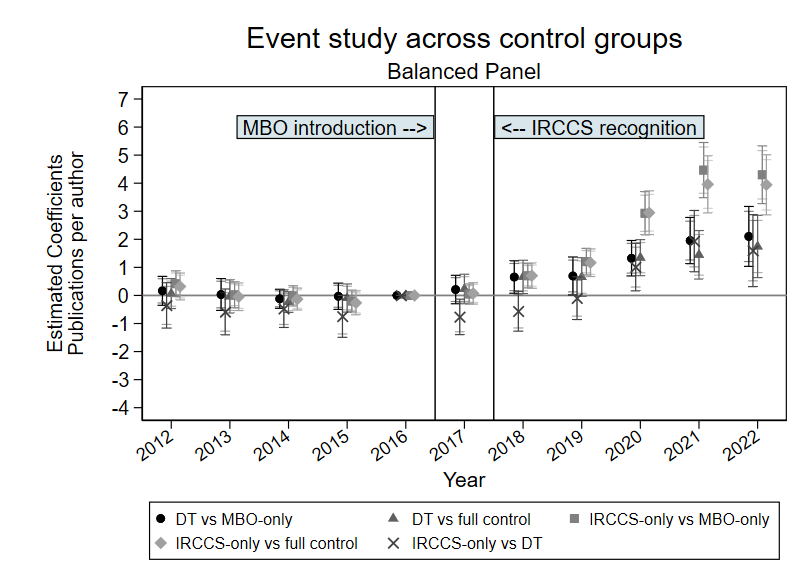
This paper studies how different organizational approaches affect scientific productivity among high-skilled workers. We compare a managerial intervention that increases the returns to research through performance-based incentives with an institutional change that expands research capacity through public funding and organizational support. Exploiting two policies within a large research-intensive Italian university hospital and detailed physician-level panel data from 2012–2022, we estimate the effects of both interventions using a set of difference-in-differences strategies. We find that performance incentives alone do not significantly increase scientific output. By contrast, expanded research capacity generates a large and persistent increase in productivity among researchers exposed to the new research environment. The results reveal substantial heterogeneity across workers: individuals already engaged in research-intensive activities respond strongly to expanded research capacity, whereas physicians primarily devoted to clinical tasks show limited responses to publication-based incentives. The increase operates primarily through the intensive margin, reflecting the expansion of existing research teams and activities rather than the emergence of new collaboration patterns, scientific leadership or research specialization. While total citations increase, citations per publication decline, suggesting a quantity–quality trade-off. Consistent with a broader expansion of research-related activity, we also document increases in high-complexity clinical procedures, with no systematic changes in healthcare quality indicators. The findings suggest that policies designed to increase scientific output are not necessarily the same as policies capable of transforming the research process itself.
Keywords: High-skilled Workers, Knowledge Production, Management-By-Objective, Public Funding, Healthcare Research
JEL Classification: I10, I23, J24, O31.