Home
I obtained my PhD in Economics and Finance at Università Cattolica del Sacro Cuore — DEFAP School in 2026, supervised by Gilberto Turati and Luca Salmasi.
In 2025 I was a visiting researcher at IEB — Universitat de Barcelona, hosted by Judit Vall Castelló. I was born and raised in Rome and earned my MSc at Sapienza University of Rome in 2021.

Research
Working Papers
Do Vaccination-Based Access Restriction Policies Curb Hesitancy? A Comparison between Italy and Spain

Abstract
Vaccine hesitancy is a crucial public health issue worldwide. In this paper, we evaluate the causal impact of a vaccination-based access restriction policy on vaccine uptake by exploiting the introduction of the EU Digital COVID-19 Certificate at the country level. We compare two countries, Italy and Spain, which—despite using the Certificate as a prerequisite for many daily activities—experienced different adoption patterns. In Spain, the Certificate was introduced regionally, temporarily suspended by the Courts, and later reintroduced in several regions. In Italy, it was introduced in June 2021 and progressively expanded, culminating in mandatory vaccination for individuals aged over 50. We test the impact of the Certificate on vaccination rates using a Sharp Regression Kink Design, identifying changes in the slope of vaccination rates around the announcements by the two governments relative to the introduction of the Certificate. We find that the digital COVID-19 Certificate increased vaccinations in Italy in a range spanning from 3.12 to 11.03 percent. In Spain, by contrast, only the reintroduction seems to have been able to affect vaccinations. This result for Spain is also supported by a Difference-in-Differences model, exploiting the staggered reintroduction of the Certificate at the regional level.
JEL Classification: I12, I18
Keywords: vaccine hesitancy; Digital COVID-19 Certificate, Sharp Regression Kink Design
Informed Decision-Making for Vaginal Birth After C-Section and Repeated Cesarean Section. Does counseling make a difference?

Abstract
The global increase in Caesarean Section (CS) rates is a concern for maternal and newborn outcomes and healthcare costs. While vaginal birth after caesarean VBAC) is often a safe and cost-effective option, elective repeat caesarean sections (ERCS) remain overused. Global clinical guidelines stress indeed the role of counseling and shared decision-making, but the empirical evidence on their effectiveness is limited. In this paper, we aim at assessing whether counseling is associated with a higher likelihood of choosing VBAC rather than ERCS among eligible women, controlling for socio-demographic factors and previous delivery experiences. We administered a structured questionnaire to women, all eligible to VBAC, with one previous CS who gave birth again in 2023 in a major private Hospital in Rome,after having attended counselling sessions related to the VBAC. By running Firth logistic regressions and controlling for socio-demographics and elements linked to their past deliveries’ experience, we estimated correlations between the likelihood of opting for a VBAC and various relevant covariates. We observe that 28% of women experienced a VBAC in our final sample. When considered separately, socio-demographic factors like age and education were associated with VBAC, whereas characteristics of the previous CS were not significant. On the other side, high level of satisfaction with counseling, and attributing great importance to vaginal birth were positively associated with VBAC. The findings suggest that counseling, as long as it reinforces women’s beliefs in the importance of vaginal birth, may be able to increase the choice of VBAC among eligible women and address the concern of the widely used unnecessary CS.
JEL codes: I12, I14, I18
Keywords: C-section, vaginal birth after caesarean (VBAC), elective repeat caesarean sections (ERCS), counseling, inequality
Scaling Science? Research Capacity and Scientific Production within a Healthcare Organization
Presented at: UPF Student Seminar Series (DEB, UPF, Barcelona), III Sapienza Ph.D. Conference in Social Sciences and Economics (DISSE, Sapienza, Rome), APHEC 4th Workshop (DEI, UniGe, Genoa), Workshop on IPR, Science and Innovation (DEP, Unicatt, Milan), XXXVII SIEP 2025 (UniNa, Naples), Final Internal PhD Seminar (DEFAP, Unicatt, Milan); 5th Bank of Italy Human Capital Workshop (Poster Session, Bank of Italy, Rome); 4th Milan PhD Economic Workshop (Bocconi University, Milan); XVI NERI Workshop (UniSalento, Lecce); BSE Summer Forum, ESI Workshop (BSE, UPF-UAB, Barcelona); QuantBridge Applied Quantitative Webinar Series (online); 41st AIEL (UniRoma3, Rome)
Abstract
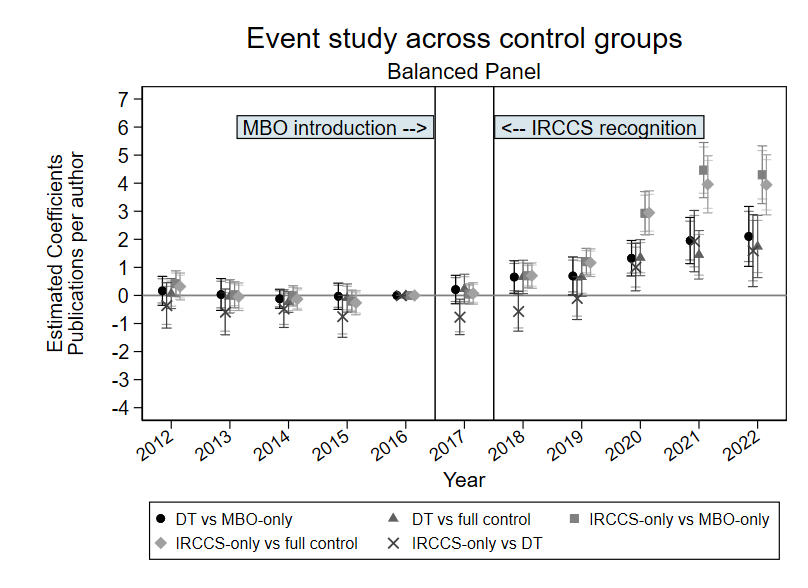
This study focuses on how an expansion in organizational research capacity affects scientific production within a large Italian university hospital. In 2018, the hospital was recognized as a Scientific Institute for Research, Hospitalization and Healthcare (IRCCS), gaining access to recurring public funding, research infrastructure, formal research lines, and organizational support. Using physician-level panel data for 2012–2022 and difference-in-differences designs, we find a large and persistent increase in publications among physicians exposed to the new research environment. The increase is concentrated among physicians who were already more research-active before recognition and occurs mainly within established scientific fields and existing collaboration networks. Field shares, the relative importance of new collaborations, and authorship patterns change little. Total citations increase, while citations per publication decline. Overall, the expansion in research capacity substantially increases scientific output but produces limited changes in how research is organized and in the composition of scientific activity. The findings show that increases in research resources can generate substantially more science without necessarily producing equally large changes in the structure of scientific production.
Keywords: Research Capacity, Organization of Science, Public Funding, Scientific Collaboration, Healthcare Research.
JEL Classification: I23, O31, O32, O38.
Household Income Uncertainty and Pregnancy Decisions: Evidence from Temporary Work Suspensions
Presented at: 1st and 2nd Internal PhD Seminars (DEFAP, Unicatt, Milan), 2nd PhD Conference in Social Sciences and Economics (DISSE, Sapienza, Rome), XXXVI SIEP 2024 (UniCg, Cagliari), 3rd Internal PhD Seminar (DEFAP, Unicatt, Milan), 17th UniTO-CCA VPDE Workshop (Poster Session, UniTo-CCA, Turin), PhD & Post-Doc UniMi Brown Bag Seminars (DEMM, UniMi, Milan), 4th Winter Symposium (DEF, UCSC, Milan), UB School of Economics PhD Seminars (UB, Barcelona), 1st WISE (Poster Session, IdeP, USI, Airolo), 2nd Verona ECWE (DE, UniVr, Verona), BSE PhD Jamboree 2025 (BSE, Barcelona), BReCHS Seminars* (DISMEQ, UniMiB, Milan), Workshop in Gender, Violence and Inequality* (DEF, UCSC, Milan)
Abstract
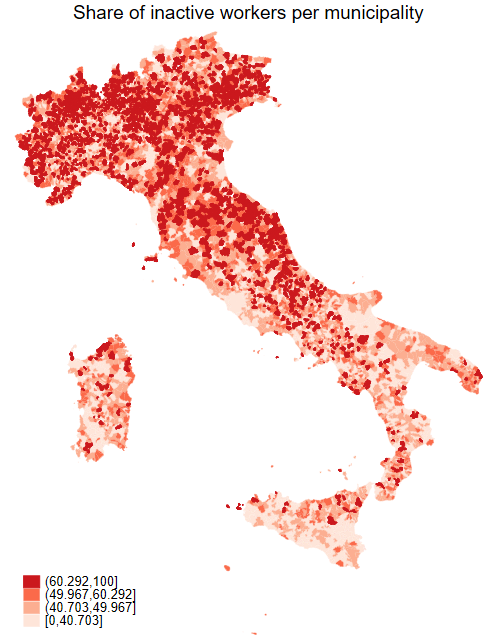
We study how uncertainty about future household income affects the decision to continue an ongoing pregnancy. To distinguish the role of uncertainty from that of realized income losses, we exploit the Italian labour-market response to the first wave of the COVID-19 pandemic. While the temporary suspension of non-essential economic activities substantially increased uncertainty about future economic prospects, workers affected by mandatory closures continued to receive income support through the national short-time work scheme. Using nationwide administrative records on voluntary pregnancy terminations and births, we combine this institutional setting with geographic variation in exposure to temporary work suspensions across municipalities. Difference-in-differences estimates show that abortion rates declined throughout Italy following the lockdown, but the decline was significantly smaller in municipalities more exposed to work suspensions. The effect is concentrated among married women, women outside the labour force, and municipalities with greater industrial employment, consistent with uncertainty affecting households whose economic prospects were more exposed to temporary work suspensions. We find no corresponding effects on births. Overall, our findings suggest that uncertainty about future household income, even in the absence of permanent job loss, can substantially affect pregnancy decisions.
Keywords: Household income uncertainty; Pregnancy decisions; Abortion; Temporary work suspensions; COVID-19.
JEL Classification: J13, I12, I18, J22.
Temperature Anomalies, Rainfall and Hazardous Drinking: Evidence from Daily UK Microdata
Abstract
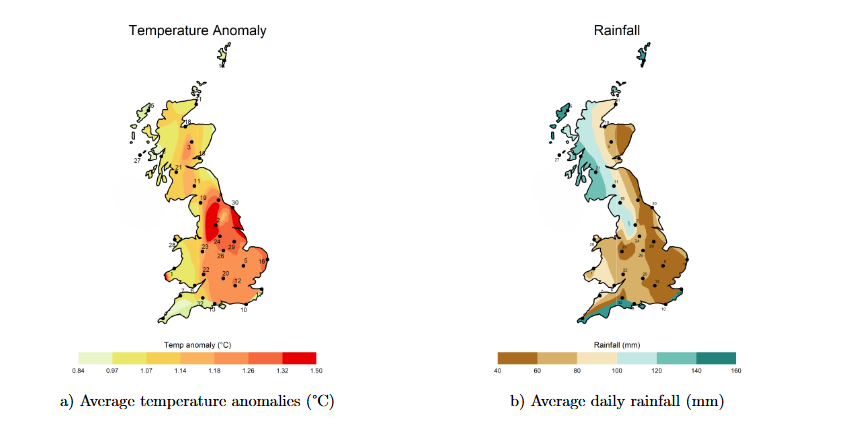
Hazardous alcohol consumption is a major public health concern, yet relatively little is known about how short-run environmental conditions shape drinking behaviour. We estimate the associations of short-run and persistent weather anomalies with drinking participation and hazardous consumption in the UK. We link six years of seven-day drinking diaries from the Alcovision survey to local meteorological observations and measure temperature anomalies relative to station-specific historical conditions and rainfall shocks using upper-tail precipitation thresholds. Weather anomalies show little consistent association with drinking participation, but persistent cold anomalies are associated with higher odds of binge, heavy-binge, and extreme-binge drinking. In the baseline specification, a 30-day cold anomaly, measured as a shock belonging to the lowest quintile of the anomaly distribution, is associated with approximately 5–9\% higher odds of binge, heavy-binge, and extreme-binge drinking. Warm anomalies are associated with lower binge-drinking odds in the upper tails of the distribution. Persistent more-severe rainfall is likewise associated with hazardous drinking. The largest seasonal cold-shock estimates for heavy- and extreme-binge drinking occur in winter. Companion and location estimates suggest that these associations vary with where and with whom drinking occurs.
JEL Classification: I12, I18, Q54
Keywords: alcohol consumption; diary data; hazardous drinking; rainfall shocks; temperature anomalies.
Weather Shocks, Water Proximity, and Conflict: Evidence from the Lake Chad Region
Abstract
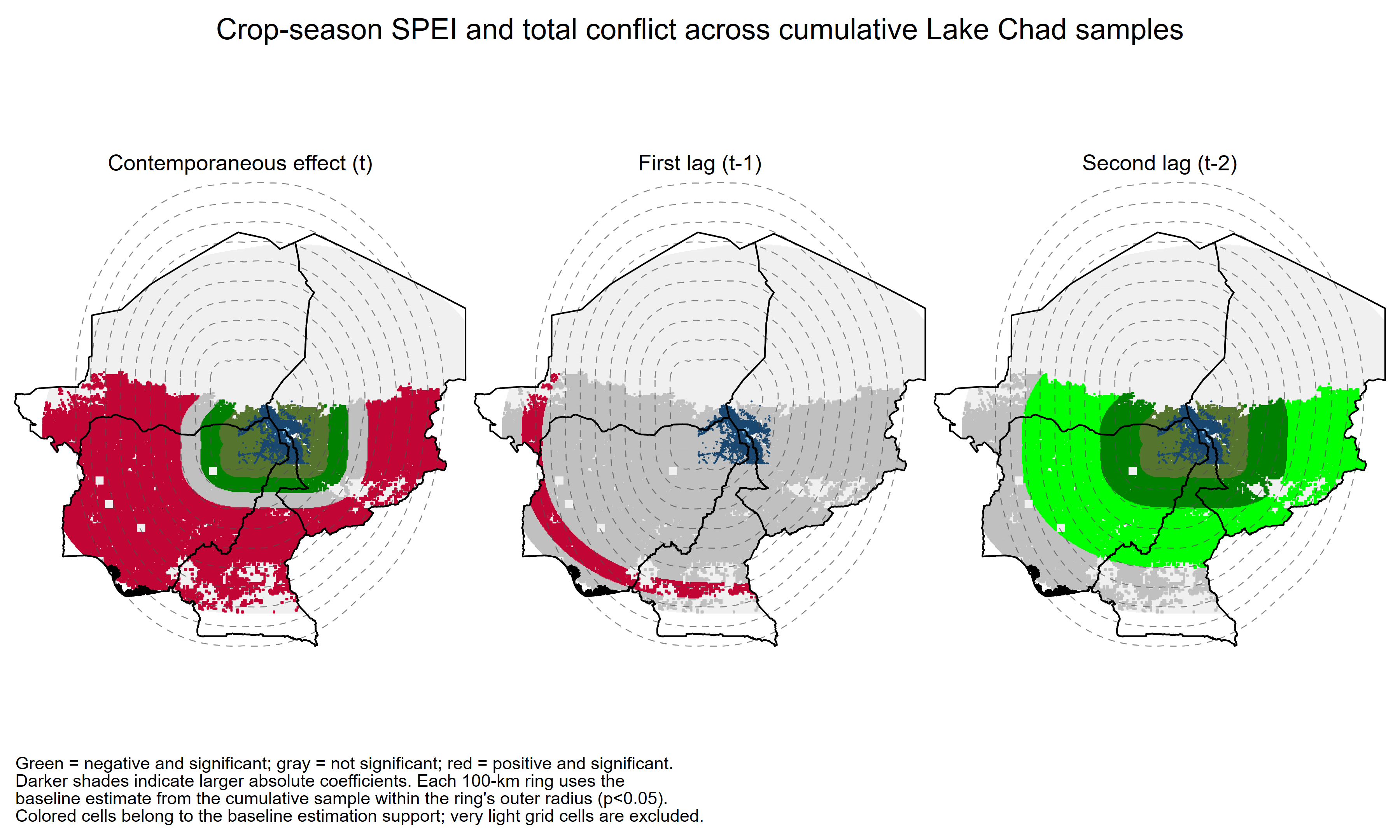
The relationship between climatic shocks and conflict remains fiercely debated. While previous research has studied weather shocks during agriculturally relevant periods, it has paid less attention to how their effects vary with proximity to water-dependent livelihoods. Using a panel of finely disaggregated grid cells across Cameroon, Chad, Niger, and Nigeria, we examine how hydroclimatic conditions during locally defined crop-growing seasons predict conflict, with particular attention to Boko Haram violence around Lake Chad. The relationship changes sharply across space. In the full sample, wetter crop seasons are followed by more conflict. Around Lake Chad, however, this pattern reverses: drier crop seasons predict greater subsequent conflict, especially Boko Haram activity, with the strongest associations emerging after two years. Within this area, the negative relationship weakens with distance from surface-water bodies. By linking crop-season shocks to the spatial distribution of water resources, our findings uncover an important source of heterogeneity in the climate–conflict relationship and help reconcile conflicting evidence in the literature.
Keywords: water scarcity; armed conflict; insurgency; Boko Haram; climate shocks; Lake Chad
JEL Classification: D74; Q25; Q54; Q56
Work in Progress
Panic at the Hospital: An Economic Appraisal of Violence Against Italian Healthcare Workers.
Presented at: IEB Internal Working Progress - IWIP (IEB, UB, Barcelona); 1st Workshop on Economics and Primary Care (Istitut Català de la Salut, Barcelona), 19th CNES - Portuguese Health Economics Conference (UPorto, Porto); XXX AIES Conference (UniVr, Verona)
Abstract
Violence against healthcare workers is a growing global concern, yet its economic underpinnings remain underexplored. This study investigates whether factors linked to healthcare supply causally affect the incidence of workplace violence in Italian healthcare settings. To this end, we construct a novel, geolocated panel dataset of over 3,500 serious assault episodes (2015–2023), scraped and classified from 23,500 news articles using LLMs. We merge this outcome with granular administrative data on hospitals, Local Health Authorities (LHAs), staffing, expenditures, and hospital performance data web scraped dynamically from official ministerial sources. Our empirical strategy relies on staggered difference-in-differences models, exploiting variation from facility closures and LHA mergers, accounting for the political alignment of regional government due to the decentralization of Italian healthcare system. Further explanations may be linked to the demand side and lack of trust towards institutions. Preliminary descriptive evidence highlights a growing and geographically heterogeneous trend in violent incidents. This work contributes to the literature on the unintended consequences of healthcare system restructuring, introducing media-sourced data as a novel proxy for stress in public service delivery.
Keywords: assaults, healthcare networks, hospital closure, medical personnel.
JEL Classification: H51, H75, I18, K42.
Incentives and Research Production in a Multitask Healthcare Setting
Abstract
Work in Progress
Researching Physicians
Abstract
Work in Progress
Other Publications
Mapping the COVID-19 epidemic in Lombardy, Italy, years 2020–2022: a population-based study of temporal trends, geographic distribution, and risk factors for incidence, hospitalization, and mortality
Abstract
Collaborative publication as member of the PASCNET study group.
Background In late winter of 2020, the first locally transmitted outbreak of COVID-19 in Europe was reported in Lombardy, Italy. This study provides a comprehensive analysis of the epidemic’s trajectory in this heavily impacted region from March 2020 to the end of 2022.
Methods We conducted a cohort study utilizing anonymized data from Lombardy’s eight local public health authorities (LPHAs). The dataset included all individuals registered with the Regional Health Service as of January 2020, with monthly data aggregated by sex, age, country of origin, municipality or ZIP area, and comorbidities. SARS-CoV-2 lineage data from the regional repository allowed us to segment the study period into four sub-periods by predominant viral lineages. We report the temporal trends and geographical distribution of three outcomes (COVID-19 incidence, hospital admissions, and mortality) as well as COVID-19 test positivity rates and vaccination coverage across LPHAs and Local Health Districts (LHDs). Multivariable regression models were employed to identify key risk factors for COVID-19 incidence and mortality in each of the four sub-periods.
Results We describe the impact of the COVID-19 pandemic in a population of over 10 million people, of whom 45% were aged ≥ 50 years and 22% had a history of cardiac diseases. The outbreak was concentrated, in the early phases, in a few LHDs, none of which had large cities. As soon as the SARS-CoV-2 transmission increased in the population, hospital admissions and mortality decreased over time, especially for areas impacted early. Our results confirm the role of age and neurologic and renal comorbidities, as well as geographical location, hinting at the impact of local epidemic dynamics and health system factors on both outcomes.
Conclusions Our findings provide essential insights into the dynamics of COVID-19 in one of Europe’s earliest and most severely affected regions, contributing valuable evidence to the global understanding of pandemic management and public health responses.
Incident diabetes within the first two years after SARS-CoV-2 infection: a population-based retrospective cohort study of the Agency for Health Protection of Milan, Italy
Abstract
Collaborative publication as member of the PASCNET study group.
Background Postacute sequelae of SARS-CoV-2 infection (PASC), including persistent symptoms and acute and chronic diagnoses, have become a major research focus. Diabetes mellitus, beyond its established link to COVID-19 severity, is increasingly recognized as a potential long-term outcome. This study investigated the association between SARS-CoV-2 infection and incident diabetes using population-level health administrative data (HAD) from the Agency for Health Protection of Milan, where the epicenter of the pandemic in Italy took place.
Methods This retrospective cohort study included adult residents without a history of diabetes who underwent SARS-CoV-2 testing between 1 March and 31 December 2020. Test-positive individuals were matched 1:1 to test-negative individuals based on sex, age, and testing week. The cohort was followed through 31 December 2021. The incidence of diabetes, identified using an HAD-based case-detection algorithm, was compared between the two groups, and in stratified analyses by sex and age, using weighted Cox models adjusted for chronic comorbidities, area-level deprivation, influenza and pneumococcal vaccinations. Weights were calculated via the inverse probability weighting approach. Effect estimates are presented as hazard ratios (HRs).
Results Our final cohort included 248,176 residents (124,026 test-negative, 124,150 test-positive). Over a median follow-up time of 415 days, 739 positive (0.60%) and 657 negative (0.53%) individuals were newly identified with diabetes. The incidence among positive individuals was 572.82 per 100,000 person-years (CI 531.52–614.12), and that among negative individuals was 509.50 per 100,000 person-years (CI 470.54–548.46). The overall HR was 1.13 (CI 1.02–1.25). In stratified analyses, this effect was prominent in women aged 41–60 years (HR 1.31; CI 1.02–1.68).
Conclusions This study provides population-based evidence supporting an association between SARS-CoV-2 infection and newly detected diabetes. These findings contribute to understanding the long-term health impact of COVID-19 and may inform public health strategies for PASC prevention and management.
Valutazione degli effetti indiretti dell’epidemia da Covid-19 sul sistema sanitario Lombardo
Abstract
Nel presente studio vengono analizzati gli effetti indiretti della diffusione dell’epidemia da Covid-19 sull’erogazione di prestazioni ambulatoriali in Lombardia, sfruttando dati amministrativi relativi a 7 Agenzie per la Tutela della Salute, nel periodo 2018-2021. I risultati mostrano un calo significativo e persistente nell’erogazione di prestazioni ambulatoriali su tutto il territorio regionale, con alcune differenze tra le diverse tipologie di prestazioni (ordinarie, di pronto soccorso e di screening), fasce di popolazione e aggregati territoriali. Complessivamente viene stimata una perdita cumulata nell’erogazione di servizi ambulatoriali di circa il 23% nel periodo, che equivale ad un ritardo cumulato di circa 6 mesi standard.
Keywords: Covid-19, Prestazioni ambulatoriali, Sistemi sanitari, Lombardia.
JEL Classification: I10, I12, I18.
Eredità universale e concentrazione di ricchezza in Italia.
Abstract
Gabriele Letta esamina la concentrazione dei patrimoni in Italia e le potenziali implicazioni distributive di un’eredità universale. Dopo una sintetica descrizione delle differenze tra i trend di concentrazione che emergono dai dati amministrativi e da quelli statistici, Letta effettua alcune simulazioni statiche sui dati survey della Banca d’Italia (SHIW, 2016), comparando, in diversi scenari, gli effetti redistributivi di una patrimoniale e di un trasferimento universale di capitale ai giovani.